
Digital receipts vs paper receipts: what works better for merchants?
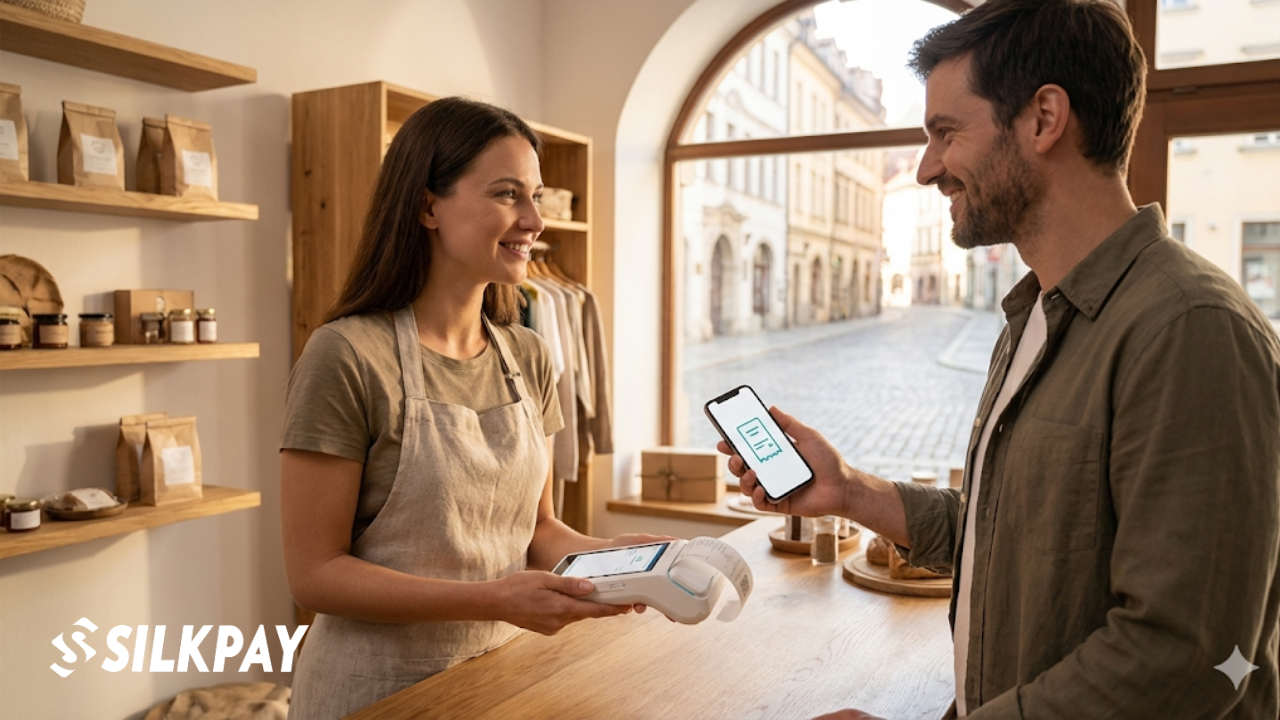
Paper receipts have long played an important role in daily business operations. They are familiar, easy to understand, and in some cases still necessary. For many merchants, paper receipts have simply been the default option for years.
In restaurants and retail stores, the checkout process should be fast and efficient, however, there is always a small issue that obstructs payment: Paper receipts.
Printing a receipt requires regular maintenance of the equipment. If your thermal paper happens to jam, or if it runs out and needs a refill, the checkout process slows down instantly.
At the same time, customer habits have changed. Many customers no longer want to keep paper receipts, especially tourists and digital-first consumers who prefer to receive it in a digital format.
The question today is not whether paper receipts work, but whether they are still the most efficient option for modern businesses. As payments become more digital, more merchants are rethinking the role of receipts.
Switching to E-receipts is not just about reducing paper usage. It is also a practical way to simplify operations, speed up checkout, and better align with modern customer behavior.
In this article, we focus on analysing the reasons behind the fact that European merchants are switching to E-receipts, then we’ll show how electronic receipts have become a vital component within Silkpay’s payment systems that enables merchants to better adapt to international customers and changing consumer habits.
Why more merchants are switching to e-receipts
Advantages for merchants
Lower costs and fewer checkout disruptions:
Electronic receipts eliminate the need for printed paper, which helps merchants reduce spending on thermal paper, printer consumables, and device maintenance.
They also prevent checkout delays caused by paper jams, empty paper rolls, or printer failures.
During busy hours, electronic receipts can keep the checkout process consistent, reliable, increase customers satisfaction and improve overall operational efficiency.
More efficient financial management:
Traditional POS systems usually print multiple copies of a receipt, one for merchant records and another for the customer. Although the intended use is labeled on the receipt, staff may still confuse copies in fast-paced, high-volume environments, which can lead to accounting errors.
Electronic receipts are generated and stored automatically. They can be delivered to customers while ensuring merchant records remain accurate, complete, and traceable. This approach significantly reduces manual errors and unnecessary duplicate work.
No additional integration needed:
Electronic receipts are built-in to all the POS solutions offered by Silkpay. Our merchants can send them to customers via email.
Deeper operational and data insights:
Each electronic receipt creates a digital record that can be analyzed over time. Merchants can use this data to understand customer behavior, peak transaction periods, and best-selling products. These insights support better decisions in inventory planning, staff scheduling, and targeted marketing initiatives.
Advantages for customers
Sustainable and easier to manage:
European consumers have shown growing concern for sustainability and environmental responsibility. In France, more than 30 billion paper receipts are printed each year across stores, supermarkets, restaurants, and other retail settings. According to research conducted by the polling institute OpinionWay, approximately 73% of consumers support reducing the use of paper receipts.
Electronic receipts eliminate paper consumption and the environmental impact associated with thermal paper printing, while still preserving valid proof of purchase. They also make records easier to organize, manage, and store over the long term.
Better aligned with the needs of international travelers:
For outbound and international travelers, the maintenance of transaction records is a practical requirement for reimbursement or tax refund purposes. Many countries require customers to present valid proof of purchase when applying for tax refunds, and e-receipts are easy to store, retrieve, and submit when needed.
For Asian travelers in particular, digital receipts offer added convenience, as they can be saved directly on a mobile device without the risk of losing paper receipts during a trip. This improves the overall cross-border shopping experience and customer satisfaction.
Easier after-sales service and returns:
Electronic receipts can be accessed by customers at any time for returns or after-sales service. Whether items are returned in store or an online service request is submitted, customers can present their digital proof of purchase directly.
How Silkpay helps merchants send electronic receipts
Silkpay POS systems:
Silkpay‘s PAX A920 Pro terminal, supports not only e-receipts, but also every mainstream global payment method, including Visa, Mastercard, Google Pay, Apple Pay, Alipay+, and WeChat Pay, allows merchants to serve both local customers and international tourists.
After a transaction is completed, merchants can choose to send an e-receipt via email to their customer.
E-receipts are only sent when customers actively provide their contact information, helping merchants comply with European data protection regulations and customer consent requirements, which can avoid risks associated with automatically collecting personal data.
Also, e-receipts are not mandatory. At Silkpay, merchants have the choice to offer paper or digital receipts according to customer preferences.
For restaurants, retail stores, and tourism-related businesses, this optional approach allows for a gradual integration of digital receipts into current operations.
QR code payments:
A lightweight, cost-efficient solution
Digital transformation does not necessarily require investment in additional hardware equipment or increased operational complexity.
With Silkpay’s QR code payment solutions, including Alipay+, WeChat Pay and UnionPay Yunshanfu QR codes, merchants can accept payments without new payment devices.
A single QR code can reach over 2 billion users and can be easily printed and displayed at the checkout counter. It requires no modifications to existing POS systems.
This low-barrier deployment makes QR code payments particularly suitable for small businesses, merchants who serve a large base of Asian customers, or businesses that need flexibility to adapt to changing customer traffic.
Real-time transaction records:
Another key advantage of QR code payments lies in the real-time visibility of transaction data. Once a payment is completed, transaction records are instantly synchronised with the merchant system, allowing for efficient settlements and daily financial management without additional steps.
At checkout, merchants do not need to ask customers to manually provide an email address to receive a payment confirmation. This reduces friction during the payment process, minimising the risk of input errors by staff.
Contact us for more information about E-receipts.
Conclusion
The shift from paper receipts to electronic receipts reflects a broader transformation in how checkout is defined.
For European merchants, the adoption of electronic receipts is less about following trends and more about adapting to operational realities and customer behaviour. With the growth of digital tourists and their growing expectation, merchants require solutions that integrate into existing workflows.
Silkpay positions electronic receipts as a flexible alternative that supports rather than a required change. Merchants can offer digital receipts at opportune moments while retaining full control over user consent and checkout speed.
When small inefficiencies add up quickly, modernised receipts become a practical step toward building more resilient and future-ready checkout experiences.
About the author: Silkpay
Based in Paris, Silkpay provides omnichannel and secure payment solutions to help physical stores and e-commerce in Europe and the Americas accept more than 30 of the world's most popular payment methods: Visa, Mastercard, CB, UnionPay, Alipay+, WeChat Pay as well as Asia-Pacific’s major e-wallets.
Silkpay is a winner of the LVMH Innovation Award. The company was also selected as a finalist for the "Money 20/20" Best Startup and in the "MPE Berlin” Startup Awards. Silkpay also won the "Best Fintech" awards from Capgemini and BPCE.
Silkpay helps merchants deliver the smoothest payment experience to their customers. We are a talented and international team driven by a single goal: to improve the customer experience and make payments simple and secure.